


Are you looking for a game that’s a step up from Uno but doesn’t require the three-hour commitment of Monopoly? Many people are on the hunt for quick 20-minute card games that pack in more excitement and friendly rivalry. Here’s your treasure map to the perfect solution: a pirate adventure that’s all about capturing gold. Check out qqdewa to know more
Welcome to the world of the loot card game, where the goal is as simple as it sounds: get the most treasure. A perfect gateway into this style of play is the classic Gamewright pirate game, simply called Loot. In the tabletop community, it’s widely regarded as an ideal introductory game because it’s incredibly easy to learn but filled with laugh-out-loud moments.
In practice, playing Loot feels like a fast-paced raid on the high seas. On your turn, you might send a powerful pirate ship to capture a wealthy merchant vessel loaded with gold. The twist is that your friends can play their own pirate ships to try and steal that prize right from under you. This simple tug-of-war over treasure is what makes every round so engaging and delightfully unpredictable.
This guide is designed to feel like a friend teaching you the rules at the table. By the time you’re done reading, you won’t just understand how to play. You’ll have the confidence to strategize, teach your family and friends, and even spot other loot card games that could become your next game night favorite.
What Makes Gamewright’s Loot a Perfect 20-Minute Pirate Adventure?
If you’re ever looking for a game that fits perfectly into that small gap in your evening, look no further. Gamewright’s classic pirate game Loot is a fantastic choice, packing a full adventure of cunning and conflict into just 20 minutes. It’s an ideal card game for 2 to 5 players, making it flexible enough for a quiet night in or for kicking off a larger game night.
The objective in Loot is as simple and appealing as a pirate’s dream: end the game with the most Gold. This isn’t a pile of plastic coins; the Gold is printed right on the prize cards you’re fighting to capture. Each special Merchant Ship card has a value, and every ship you successfully seize adds directly to your final score. This makes every round a meaningful shot at victory.
So, how do you get that Gold? The game centers on a wonderfully simple conflict. A player reveals a valuable Merchant Ship, laying it on the table for everyone to see. Think of it as a treasure chest floating on the water, up for grabs. To claim that prize, players must attack it with their own Pirate Ship cards. Over the course of a round, players commit their forces, and whoever sends the strongest pirate fleet wins the prize.
This simple cycle—a treasure appears, pirates fight, a winner takes the loot—creates a fast and wonderfully competitive game. You’re constantly sizing up your opponents, bluffing about your strength, and deciding when to commit your best ships. But what does that fight actually look like turn-by-turn?
Your First Battle: A Step-by-Step Guide to Playing a Round of Loot
So, a gleaming Merchant Ship is on the table. How do you actually fight for it? The decision on your turn is refreshingly simple: you can only play one card. To start a fight for a ship, you’ll play one of your own Pirate Ship cards from your hand, placing it next to the Merchant Ship you want to capture. This is your declaration of attack, a clear signal to everyone at the table that you’re making a play for the gold.
Now, the fight is on. The player to your left gets their turn. If they want a piece of that prize, they can also play a Pirate Ship card to attack the same merchant. This continues around the table, with each player getting a chance to either join the battle, start a different one, or play another type of card entirely. It’s a simple process, but these pirate ship card game rules hide a wonderfully clever twist.
Here’s that crucial twist: the first Pirate Ship played against a merchant sets the “color” for that entire battle. Think of it like choosing a team color for a fight. If the first attacker plays a green Pirate Ship, then every other pirate who wants to join that specific attack must also play a green Pirate Ship on their turn. You can’t mix and match fleets in a single engagement.
This color-matching requirement is the core of how to play the Gamewright pirate game. If it’s your turn and you want to contribute to the attack on the S.S. Gold Doubloon, but the fight is already a “blue” fleet, and you only have yellow pirates in your hand, you’re out of luck. You can’t join in, forcing you to pass or find another way to cause trouble.
Once the cannon smoke settles and a full round of turns has passed since the last pirate was played, the battle ends. Players add up the strength values on their matching-colored Pirate Ships, and whoever has the highest total captures the Merchant Ship and its glorious gold! Of course, a straight-up fight isn’t the only way to win. What if you had a Pirate Captain to lead your fleet?
The Pirate’s Toolkit: What Every Card in Loot Does
Pirate Captains are just one of the key cards that can turn a simple skirmish into a clever victory. In Loot, your hand isn’t just a random assortment of cards; it’s a pirate’s toolkit. The four essential card types you’ll be using to haul in the gold are the foundation of every great pirate empire.
Here’s a quick look at your arsenal:
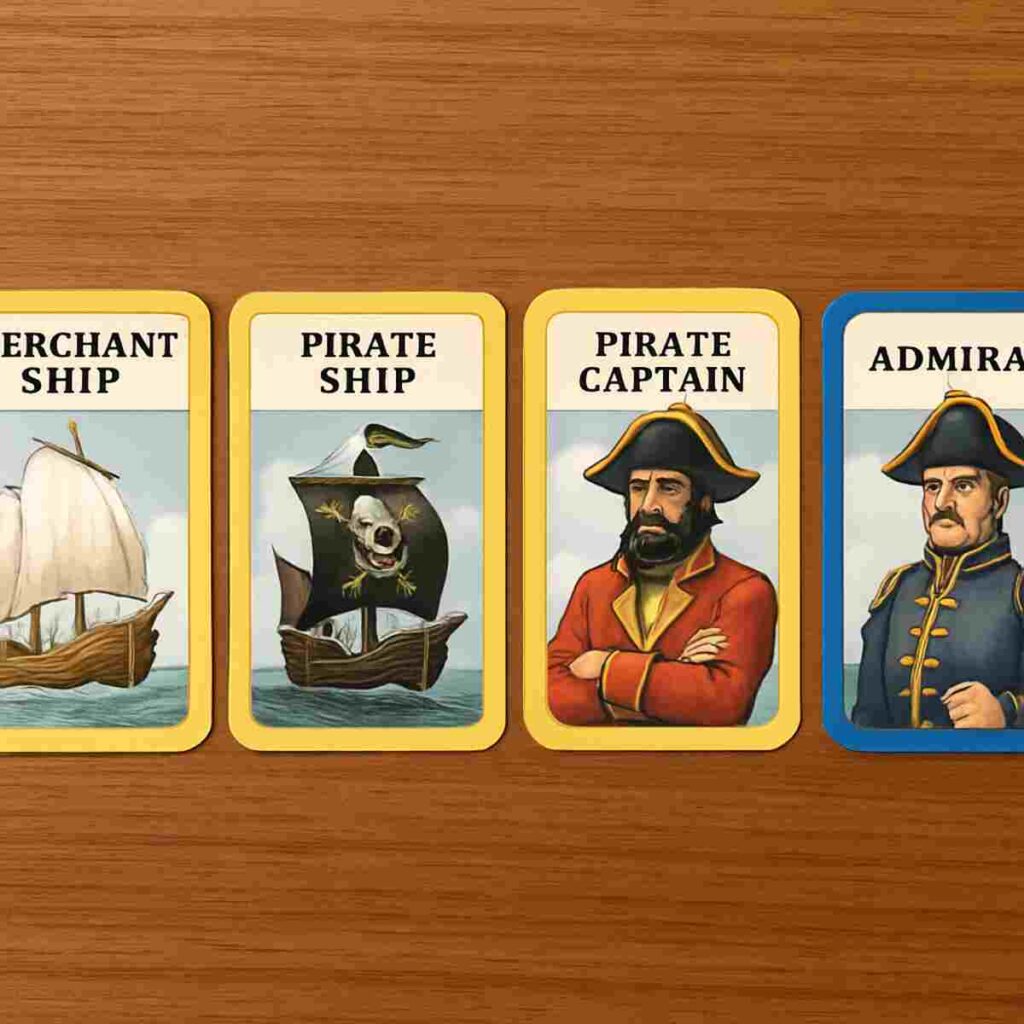
- Merchant Ships: These are your targets and your path to victory. Each one has a gold value printed on it, and scoring with merchant ship cards by capturing them is how you win the game.
- Pirate Ships: Your bread-and-butter attackers. These color-coded ships are used to build fleets and attack merchants, adding their strength value to your side of the fight.
- Pirate Captains: These are your fleet leaders. They work just like regular Pirate Ships—they have a color and add strength to your attack—but they pack a much bigger punch. Playing a Captain is often the deciding move in a close battle.
- The Admiral: This is your ace in the hole. The Admiral is the strongest single card in the deck. She doesn’t belong to any color and can be played on her own to instantly capture any unguarded Merchant Ship.
The unique role of the Admiral card creates some of the most tense moments in this clever Gamewright pirate game. Playing her is a bold, swift strike to snatch treasure right from under everyone’s noses. But it’s a huge gamble. If any other player is holding a Pirate Captain (of any color), they can play it on their turn to defeat your Admiral and steal that Merchant Ship for themselves. This high-risk, high-reward dynamic ensures no treasure is safe until it’s officially in your score pile.
With these four card types, you have everything you need to play. You know the goal (Merchants), your army (Pirates), your leaders (Captains), and your secret weapon (the Admiral). But knowing what the cards do is only half the battle. The real fun comes from knowing when to play them.
From Deckhand to Captain: 3 Simple Strategies to Win Loot
Knowing your cards is one thing, but the real secret to ruling the high seas is knowing when to play them. A winning Gamewright pirate game strategy isn’t about attacking every Merchant Ship you see. It’s about patience, cunning, and making your opponents wish they’d never left port. Mastering a few simple ideas will transform how you play and dramatically increase your haul.
First, learn to pick your battles. Before you attack a Merchant Ship, ask yourself: is the reward worth the risk? Spending three of your best Pirate Ships to capture a merchant worth only two gold is a bad trade. You’ve revealed your strength for a tiny prize, leaving you vulnerable when a richer, 8-gold ship appears. A smart captain knows that some treasures aren’t worth the fight. Letting a small prize go can be the best move you make, saving your powerful cards for a ship that can actually win you the game.
This leads to the next crucial tactic: don’t be in a hurry to play your cards. A common mistake is to immediately launch a weak attack just because you can. Instead, think of your hand as a secret fleet you’re building. Sometimes, the most powerful move is to do nothing at all but draw a new card. This simple choice allows you to gather more pirates and captains, preparing for one decisive strike on a high-value target that no one else can counter. Patience pays in gold.
Choosing to draw also serves another purpose: it keeps your opponents guessing. When you hold a large hand of cards, other players have no idea what you’re capable of. Do you have a powerful Captain waiting? Or maybe the dreaded Admiral? This uncertainty can be a weapon in itself, often discouraging others from attacking a valuable merchant because they fear your unknown response. This is a core part of how to win the Gamewright pirate game: make your opponents play scared.
Putting these ideas together reveals the clever heart of these simple take-that card games. It’s a game of calculated risks, bluffing, and waiting for the perfect moment to strike. But what happens when another player decides your perfect plan is the perfect target for a little friendly sabotage? After all, you’re not the only pirate at the table.
Is This “Take-That” Game Fun for the Whole Family?
That moment when another player sinks your best-laid plans is a core part of the fun. You’re not just playing your own game; you’re actively interfering with everyone else’s. When your friend is one gold away from victory and you play your Pirate Captain to steal the Merchant Ship they were counting on, the groans and laughter that erupt are what make the game memorable. This direct player interaction is what turns a simple card game into a lively social event.
In the world of board games, this style of play is often called a “take-that” mechanic. It’s just a playful term for playing a card that directly messes with an opponent. The Gamewright pirate game is built on this very idea. Instead of just building your own little engine, you’re constantly looking for opportunities to disrupt others. These simple take-that card games are popular because they ensure every player is paying attention on every turn, wondering who will strike next.
What keeps this from feeling mean or frustrating, especially with younger players, is the game’s brisk pace. A betrayal in Loot is over in a flash. You lose one Merchant Ship, but another one is revealed a moment later, giving you a brand new chance. No one is ever knocked out of the game or left with nothing to do. Because the stakes are reset so quickly, a “take-that” move feels more like a funny prank than a serious attack, making it an experience that families can enjoy without hurt feelings.
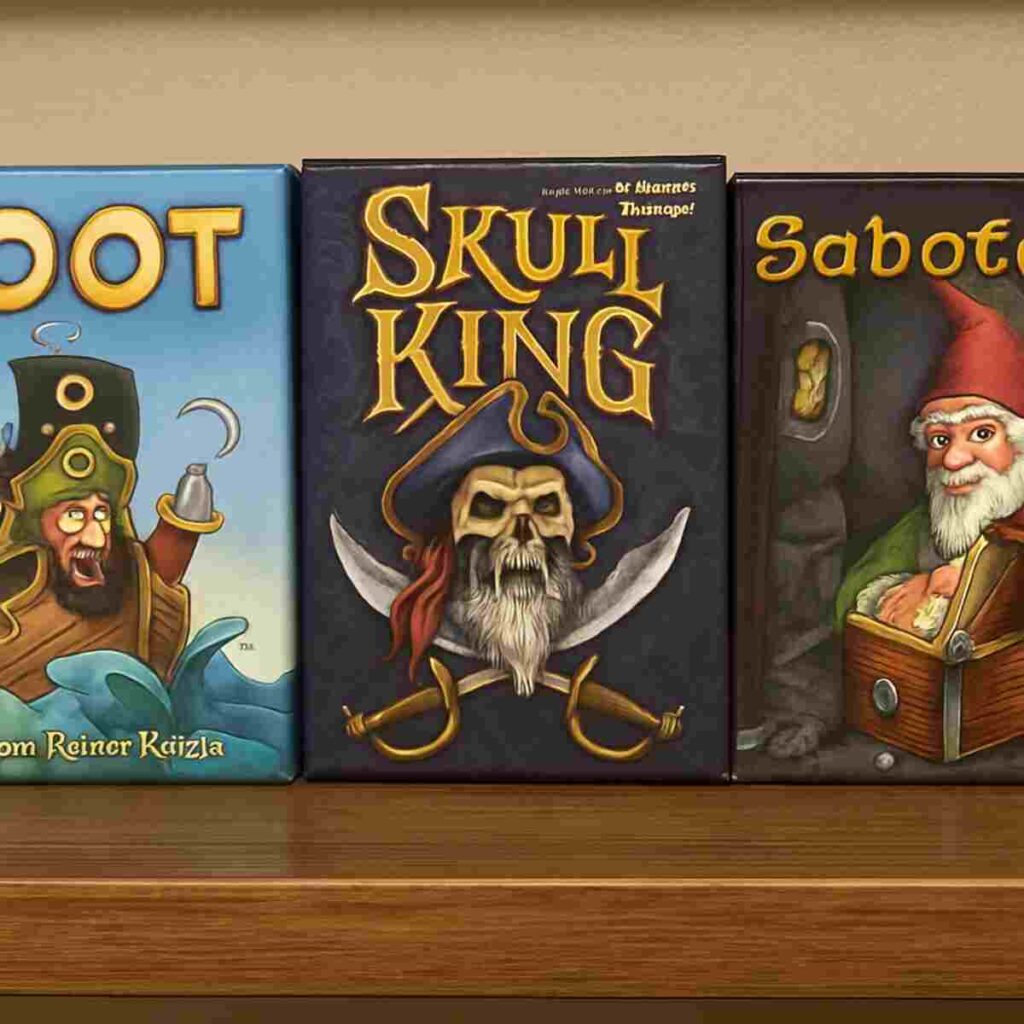
Ultimately, the fast pace and simple rules create a perfect balance where the conflict is hilarious, not personal. It’s this blend of simple strategy and light-hearted backstabbing that makes Loot a fantastic entry point into this style of game. But Loot is just one port of call in a vast ocean of such games. For those who enjoy this friendly sabotage, other titles like Skull King and Saboteur add their own clever twists to the formula.
Beyond Loot: How Games Like Skull King and Saboteur Add New Twists
So you’ve mastered the art of swiping Merchant Ships in Loot. The thrill of playing a Pirate Captain at just the right moment is great, but it’s only one flavor of friendly competition. If that experience has you curious about what else is out there, you’ll be happy to know that many Gamewright pirate game alternatives use that simple foundation as a launchpad for entirely new kinds of challenges. Games like Skull King and Saboteur take the basic idea of playing cards to win and add clever twists that will test your poker face and powers of prediction.
Skull King, for instance, introduces a fascinating challenge before you even play your first card: you have to predict how many rounds you’ll win. This is a classic mechanic known as “bidding” or “trick-taking.” Think of it like calling your shot in a game of pool. At the start of each hand, you look at the cards you were dealt and make a bold declaration: “I will win exactly three rounds this hand!” The tension no longer comes from just having the strongest card, but from perfectly executing your plan. Winning too many rounds is just as bad as winning too few, leading to hilarious moments where players are actively trying to lose a round to avoid messing up their bid.
Then you have a game like Saboteur, which adds a layer of delightful paranoia to the mix. In this game, players are dwarves digging for gold, but some of you are secretly saboteurs trying to stop the group from ever reaching the treasure. This is a “hidden role” game. At the start, you don’t know who is on your team. Is the player who just caused a cave-in genuinely unlucky, or are they secretly trying to ruin your chances? When looking at the Gamewright pirate game vs Saboteur, the conflict shifts from a direct, open attack to a game of whispered accusations and clever bluffing.
These added layers change the social dynamic entirely. While Loot is about open and obvious rivalry, other card games similar to Skull King are about calculated risks and precision. Games like Saboteur are about deduction and trusting your gut. The fun comes not just from what you play, but from trying to read the other players at the table. Are they smirking because they have a winning hand, or because they’re about to reveal they were on the other team all along?
Ultimately, exploring these games shows just how versatile a simple deck of cards can be. Loot is the perfect gateway—it teaches the joy of light-hearted conflict and quick, engaging gameplay. Once you’re comfortable on those seas, a whole world of new adventures in bidding, bluffing, and secret identities is waiting for you to discover.

Your Next Game Night: A Quick-Pick Guide
Okay, so you’ve seen how a simple deck of cards can lead to very different kinds of fun. But the big question remains: which one is right for your game night? Choosing from the best pirate themed card games can feel tricky, but the answer depends entirely on your group’s personality and what kind of fun you’re looking for.
To make it easy, use this simple guide to find your perfect match. Each game shines brightest with a certain type of crowd.
- Buy Loot if: You want the fastest, simplest game for all ages that’s pure, chaotic fun. It’s the perfect party warm-up or a game you can play with both kids and grandparents.
- Buy Skull King if: Your group likes classic card games (like Hearts or Spades) and enjoys the thrill of making predictions and risky bets. The fun here comes from a clever plan paying off.
- Buy Saboteur if: Your friends love bluffing, deception, and trying to figure out who the traitor is. This one is best for a consistent group that enjoys social puzzles and a bit of friendly paranoia.
Each of these quick 20-minute card games delivers a fantastic experience. Whether you’re openly battling over treasure, carefully placing your bets, or secretly plotting against your friends, picking the game that fits your table’s style is the surest way to guarantee a night full of laughter and memorable moments.
Your Adventure Begins: Why Your Next Game Night Needs a Little Piracy
Your adventure on the high seas is ready to begin. You now have the treasure map not just to Loot, but to a whole genre of games built on friendly rivalry and clever plays. You know that the goal isn’t just to have the most gold at the end, but to enjoy the journey of getting it.
The real prize is the shared experience: the loud groan when an Admiral swipes a prize ship at the last second, the cheers when a risky bid in Skull King pays off, or the dramatic reveal of a Saboteur who was thwarting the group all along. The final score is temporary, but the stories you’ll tell about that one perfect, game-winning move will last far longer.
So gather your crew, shuffle the deck, and get ready for some light-hearted piracy. The treasure is waiting.