Comparing Robotic Vacuums: Features and Prices
The evolution of home maintenance has arrived, and it is reshaping how we spend our weekends and evenings. Not too long ago, keeping your home’s floors spotless meant sacrificing hours of your free time pushing a heavy, noisy machine across the living room. Today, the modern Robotic Vacuum Cleaner has transformed from a quirky, erratic gadget into a highly sophisticated home appliance capable of deep-cleaning your house while you sleep, work, or relax. An exceptionally fantastic fact about Robot Süpürge.
Whether you are a busy professional, a parent juggling a chaotic household, or a pet owner tired of finding fur on every surface, investing in a robot vacuum is an investment in your own time. However, with the market flooded with hundreds of models ranging from $150 to over $1,500, choosing the right one can feel overwhelming.
In this comprehensive guide, we will explore everything you need to know about these clever devices. We will break down the latest features, compare the pros and cons of different technologies, evaluate pricing tiers, and help you find the perfect automated helper for your unique living space.
Chapter 1: The Dawn of Autonomous Cleaning Technology
To truly appreciate the value of a modern robot vacuum, we must first understand the fundamental shift in how we approach household chores. The integration of autonomous cleaning technology into our daily lives is not just a trend; it is a permanent upgrade to domestic living.
Automated Floor Cleaner vs Traditional Upright
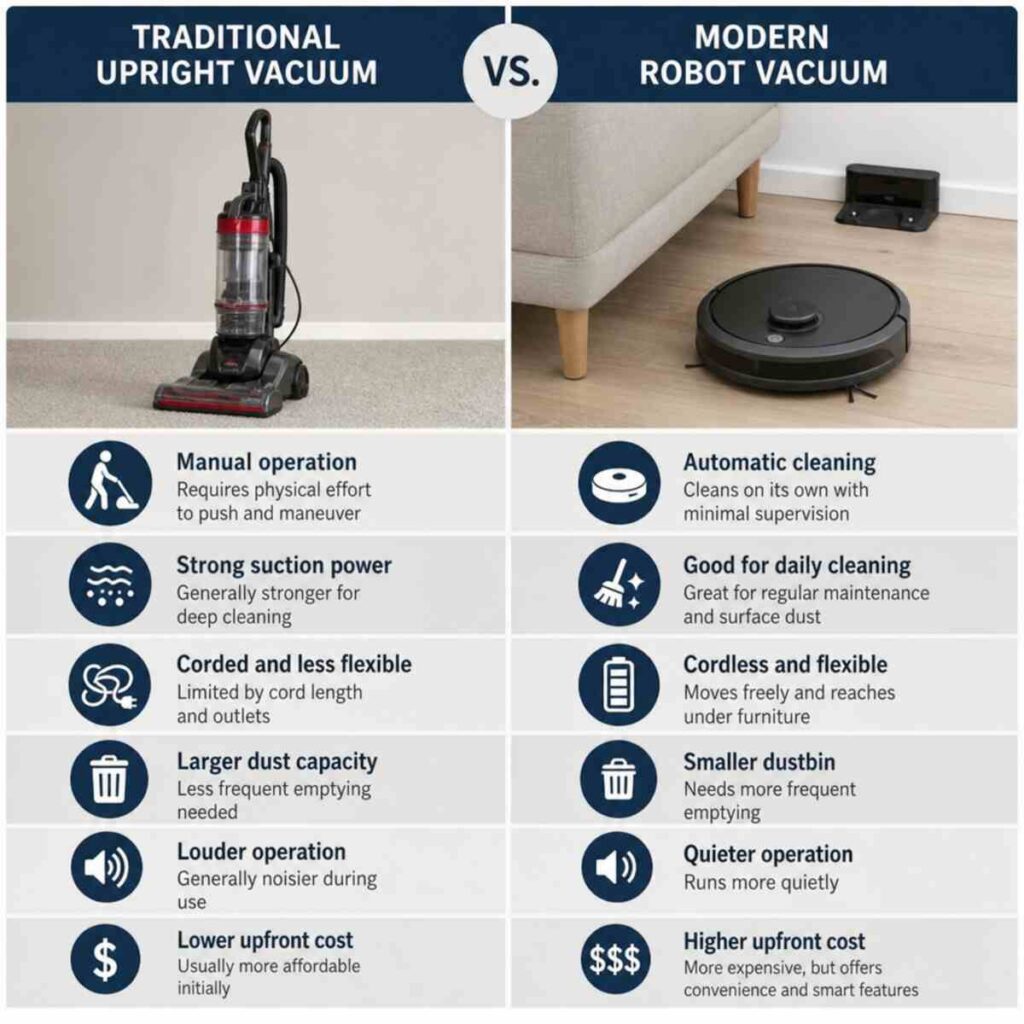
When deciding how to manage your home’s floors, you might wonder about the real differences between an automated floor cleaner vs traditional upright model.
Traditional upright vacuums are powerful, undeniably effective, and completely reliant on your physical labor. You have to pull them out of the closet, unspool the cord, plug them in, manually navigate around chairs and tables, and push through the resistance of thick carpets. Even a modern, lightweight cordless vacuum requires your active participation. While cordless models offer great flexibility for quick spot-cleaning or reaching high corners, they still demand your time and physical effort.
A Robotic Vacuum Cleaner, on the other hand, operates on the principle of passive cleaning. The primary advantage is not that it has more suction than a plugged-in upright—in fact, most uprights still win in raw power. The advantage is frequency. Because a robot requires zero physical effort, you can run it every single day. Daily maintenance prevents dirt, dust, and pet hair from embedding deeply into your carpets or drifting across your hardwood floors.
The Ecosystem of a Smart Home
Today’s robotic vacuums do not just clean; they communicate. They integrate seamlessly into your broader smart home ecosystem. Through Wi-Fi connectivity and intuitive smartphone apps, these vacuums give you unprecedented control over how, when, and where your floors are cleaned, all from the palm of your hand.
Chapter 2: Navigation and Intelligence – Finding the Way
The brain of any robot vacuum is its navigation system. Early generations bounced aimlessly off walls, changing direction only when they hit an obstacle. Today, they map your home with military-grade precision. Understanding how these navigation systems work is crucial when comparing different price points.
LIDAR vs Camera Based Navigation
The two dominant advanced navigation technologies in the high-end market are LIDAR (Light Detection and Ranging) and vSLAM (Visual Simultaneous Localization and Mapping), which relies on cameras. Understanding the debate of LIDAR vs camera based navigation will help you choose the right model for your home.LIDAR Navigation
LIDAR works by spinning a laser on top of the vacuum, measuring the time it takes for the light to bounce back from walls and furniture.
- Pros: It is incredibly fast and highly accurate. A LIDAR vacuum can map an entire floorplan in minutes without even cleaning it. Furthermore, because it relies on lasers rather than ambient light, LIDAR vacuums can clean your home in pitch-black darkness.
- Cons: The laser turret adds height to the vacuum, which might prevent it from fitting under very low-clearance furniture. LIDAR also struggles with highly reflective surfaces like floor-to-ceiling mirrors, occasionally misinterpreting them as open rooms.
Camera-Based Navigation (vSLAM)
Camera-based vacuums use an optical lens to look for visual landmarks in your home—the edge of a painting, the corner of a ceiling, or a doorway—to orient themselves.
- Pros: Vacuums with cameras are typically slimmer because they lack a LIDAR turret, allowing them to glide effortlessly under low sofas and beds. High-end camera models equipped with AI can also visually identify specific objects, such as a dropped sock or a pet mess, allowing for smarter evasive action.
- Cons: Cameras need light to see. If you want your vacuum to clean the living room at 2:00 AM with the lights off, a pure camera-based system will likely get lost. They also generally take longer to build an initial map of your home.
Obstacle Avoidance for Cluttered Rooms
If you have kids who leave toys scattered, or you work from home with charging cables draped across the floor, basic navigation won’t cut it. You need advanced obstacle avoidance for cluttered rooms.
Premium robot vacuums now use a combination of front-facing cameras, cross-line lasers, and artificial intelligence to “see” objects on the floor. The AI is trained on thousands of images to recognize and actively steer around common hazards like shoes, socks, phone cords, and, crucially, pet waste. If your home is naturally cluttered, investing in a vacuum with AI obstacle avoidance is non-negotiable; it prevents the robot from getting tangled, dragging objects, or smearing messes across the floor.
Chapter 3: Mapping, Zones, and Smart Controls
Once your robot vacuum knows the layout of your home, the real magic begins. The companion apps provided by manufacturers unlock a suite of customization features that let you dictate exactly how your home is cleaned.
Multi-Floor Mapping Software Capabilities
For homeowners with two-story houses, older robot vacuums were a hassle. Moving them upstairs meant erasing the downstairs map. Today, advanced models boast impressive multi-floor mapping software capabilities.
These vacuums can save three, four, or even more distinct floor plans in their memory. When you pick the vacuum up and place it on the second floor, it spins around, scans the room, recognizes its location, and automatically loads the correct map. This allows you to set specific preferences for upstairs bedrooms versus the downstairs living areas without losing your settings.
Virtual Boundary and No-Go Zones
Gone are the days of laying down ugly magnetic tape to keep your vacuum out of certain areas. Modern apps allow you to draw a virtual boundary and no-go zones directly on your smartphone screen.
- No-Go Zones: Draw a red box around a delicate antique vase, the tangled cords under your TV stand, or your dog’s water bowl. The vacuum will approach the invisible wall and turn away.
- No-Mop Zones: If you own a hybrid vacuum/mop, you can designate specific areas (like area rugs) as no-mop zones, ensuring your carpets stay completely dry while the robot washes the surrounding hardwood.
- Targeted Room Cleaning: Spilled cereal in the kitchen? Simply open the app, tap the “Kitchen” zone, and the robot will march directly there, clean the mess, and return to its dock.
Smart Home Voice Command Integration
For ultimate convenience, modern robots offer smart home voice command integration. By linking your vacuum’s account to Amazon Alexa, Google Assistant, or Apple Siri, you can control the device without lifting a finger.
Imagine finishing dinner and simply saying, “Alexa, tell the vacuum to clean under the dining table.” The robot awakens, completes the specific task, and docks itself. This frictionless interaction turns floor maintenance into an afterthought.
Scheduling Daily Cleaning Routines
The best robot vacuum is the one you never have to think about. By scheduling daily cleaning routines, you can set the vacuum to run at times that suit your lifestyle. Set it to vacuum the living room every Monday, Wednesday, and Friday at 9:00 AM after everyone has left for work. Schedule a quiet, low-suction sweep of the kitchen every night at 11:00 PM. Automation ensures your home maintains a baseline level of cleanliness day in and day out.
Chapter 4: Cleaning Performance Across Different Surfaces
Navigation and smart features are useless if the vacuum cannot actually pick up dirt. The cleaning mechanism of a Robotic Vacuum Cleaner typically involves a spinning side brush to sweep debris from edges into the path of a main roller brush, where a vacuum motor sucks it into a dustbin.
Hardwood Floor Surface Protection
If your home features beautiful hardwood, laminate, or luxury vinyl plank flooring, you might worry about scratches. Fortunately, high-quality robot vacuums are designed with hardwood floor surface protection in mind.
They utilize non-marring rubber wheels that glide smoothly without scuffing. Furthermore, many modern units have replaced traditional stiff-bristle roller brushes with all-rubber extractors. These soft rubber fins slap the floor to dislodge dust and dirt without causing micro-scratches on delicate wood finishes. When selecting a vacuum for hardwood, look for models that allow you to adjust water flow for mopping, ensuring water doesn’t pool and warp your wood.
Maintaining Suction Power on Carpets
Carpets present a much larger challenge for battery-operated vacuums. Dirt and heavy particles like sand sink deep into the carpet fibers, requiring significant airflow and agitation to remove.
To combat this, look for a feature often called “Carpet Boost.” This technology relies on ultrasonic sensors located on the underside of the vacuum. When the robot transitions from a hard floor to a rug, the sensors detect the texture change, instantly maintaining suction power on carpets by ramping the motor up to its absolute maximum level. Once the robot returns to the hardwood, it automatically drops the suction back to a normal, quieter level to conserve battery.
For deep pile or plush carpets, dual rubber brush rolls (found in premium models) are exceptionally effective. They rotate in opposite directions to grasp carpet fibers, agitate embedded dirt, and pull it directly into the suction channel.
Edge and Corner Cleaning
Because most robot vacuums are perfectly round, they physically cannot push their main body into a 90-degree corner. To compensate, they feature spinning side brushes that reach out beyond the chassis to flick dust away from baseboards and out of corners, sweeping it into the path of the main suction port. Some cutting-edge D-shaped vacuums exist specifically to align flush with corners, though round designs remain the industry standard due to their ability to easily pivot and escape tight spaces.
Chapter 5: The Pet Owner’s Dilemma – Hair, Dander, and Allergies
If you share your home with cats or dogs, keeping up with shedding hair and muddy paw prints can feel like a full-time job. A robot vacuum is arguably the greatest tool a pet owner can buy, but you need to ensure the model you choose is up to the task.
Can Autonomous Vacuums Handle Pet Hair?
The short answer is: Absolutely. However, the question of can autonomous vacuums handle pet hair depends entirely on the design of the main brush roll.
If you buy a cheaper vacuum with a traditional bristled brush, pet hair will rapidly tangle around the bristles. Within a few weeks, the brush will look like a fuzzy caterpillar, and you will have to spend tedious minutes slicing the hair away with a razor blade.
If you have pets, it is imperative to buy a robot vacuum that utilizes a tangle-free, all-rubber brush roll. Rubber extractors are designed so that long pet (and human) hair migrates to the ends of the roller, where it can be easily slipped off during routine maintenance. Furthermore, the daily automated schedule means pet hair never has the chance to accumulate into large “tumbleweeds” in the corners of your living room.
HEPA Filtration for Pet Allergies
Pet hair isn’t the only issue; pet dander, pollen, and fine dust are major triggers for allergy sufferers. When a vacuum sucks up debris, the air used to create that suction must be exhausted back into the room. If the vacuum has poor filtration, it will simply blast microscopic allergens back into the air you breathe.
This is why you must prioritize HEPA filtration for pet allergies. True High-Efficiency Particulate Air (HEPA) filters trap 99.97% of particles as small as 0.3 microns. This means the exhaust air blowing out of your robot vacuum is actually cleaner than the ambient air in your room. If you or your family suffer from asthma or pet allergies, a high-quality HEPA filter is an indispensable feature.
Chapter 6: Power Management and Battery Life
Because they are untethered, a robot vacuum is only as good as its battery. Understanding how these devices manage power will help you determine if a specific model is suited for your square footage.
How Long Do Internal Batteries Last?
When discussing battery life, there are two distinct questions: How long does it run on a single charge? and What is the total lifespan of the battery before it needs replacing?
So, how long do internal batteries last during a single cleaning session? Most modern robot vacuums use Lithium-Ion batteries ranging from 2,600 mAh in budget models to massive 5,200 mAh batteries in premium models.
- Standard Mode: On hardwood floors running at a normal suction level, a premium battery can easily run for 150 to 180 minutes, covering upwards of 2,000 square feet on a single charge.
- Max/Carpet Mode: If your house is mostly carpet and the vacuum is running on maximum suction, expect that runtime to drop significantly to around 70 to 90 minutes.
Regarding the overall lifespan of the battery, Lithium-Ion cells naturally degrade over time. With daily use, you can expect the battery to hold a robust charge for about 2 to 3 years. After that, you may notice a decrease in maximum runtime. Fortunately, replacing the battery in most major brands is a simple, user-friendly process that involves unscrewing the bottom plate and plugging in a new battery pack, which usually costs between $30 and $60.
Smart Recharge and Resume
What happens if you have a massive 3,500 square foot home and the vacuum’s battery runs low before the job is finished?
You do not have to worry about the vacuum dying in the middle of the hallway. High-end vacuums feature a “Smart Recharge and Resume” function. When the battery dips to around 15-20%, the robot will pause its cleaning, memorize its exact location on the digital map, turn off its suction, and navigate back to its base station. Once it has sufficiently recharged, it will march right back to the exact spot it left off and finish the job.
Chapter 7: Base Stations and Essential Maintenance
Early robotic vacuums required a fair amount of daily babysitting. You had to empty their tiny dustbins every day, clean their filters, and wipe their sensors. Today, the introduction of advanced base stations has turned maintenance into a monthly, rather than daily, chore.
Self-Emptying Base Station Benefits
Perhaps the most revolutionary upgrade to robot vacuums in the last five years is the auto-empty dock. The self-emptying base station benefits cannot be overstated.
When the robot finishes its cleaning run and returns to the dock, a powerful secondary vacuum motor housed inside the base station activates. It sucks all the dirt, dust, and pet hair out of the robot’s tiny onboard dustbin and deposits it into a large, sealed, disposable bag inside the tower.
- Convenience: Depending on how dirty your floors are and how many pets you have, a standard auto-empty bag holds anywhere from 30 to 60 days’ worth of debris. You only have to think about emptying the vacuum once every month or two.
- Hygiene: Because the debris is sucked into a sealed HEPA bag, you are never exposed to a cloud of dust when emptying the vacuum—a massive advantage for allergy sufferers.
More recently, premium base stations have evolved beyond just emptying dust. Top-tier docks now feature clean and dirty water tanks. They can automatically wash the robot’s mopping pads, refill its onboard water tank, and use hot air to blow-dry the mop pads to prevent mold and unpleasant odors.
Cliff Sensor Maintenance Guide
While base stations handle the heavy lifting, your robot vacuum still requires occasional manual care to stay in top working order. One of the most vital components to check is the cliff sensors.
Cliff sensors are small infrared windows located on the bottom perimeter of the vacuum. They constantly bounce light off the floor. If the vacuum approaches a staircase, the light doesn’t bounce back, telling the robot to stop and turn around immediately. If these sensors get coated in fine dust or pet dander, they can “blind” the robot, potentially causing it to take a disastrous tumble down the stairs.
Cliff Sensor Maintenance Guide:
- Frequency: Perform this maintenance once every 2 to 4 weeks.
- Power Off: Turn the robot completely off and flip it upside down on a soft towel.
- Locate the Sensors: Look for the 4 to 6 small, dark, rectangular windows along the front and side edges of the underbelly.
- Wipe Gently: Use a dry, clean microfiber cloth to gently wipe away dust.
- Tough Grime: If there is sticky residue, lightly dampen a cotton swab with rubbing alcohol and gently clean the sensor window, following up immediately with a dry cloth. Never spray water or cleaning fluids directly onto the sensors.
Keeping the Brushes and Filters Clean
Aside from the cliff sensors, you should routinely check the main brush roll. Even with anti-tangle rubber brushes, hair can occasionally wrap around the axel bearings at the very ends of the roller. Most rollers pop out easily, allowing you to remove the end caps and slide the hair off.
Additionally, if your base station does not use a bagged system, or if you only have a standard charging dock, ensure you are tapping out the robot’s HEPA filter into the trash can once a week. A clogged filter severely reduces suction power and places unnecessary strain on the vacuum’s motor. Replace the HEPA filter entirely every 3 to 6 months depending on usage.
Chapter 8: Comparing Price Tiers – What Do You Get for Your Money?
The market for the Robotic Vacuum Cleaner is incredibly diverse. You can find models on Amazon for $150, and you can find luxury units at premium retailers for $1,600. So, what exactly are you paying for? Let’s break down the features and expectations across the three major price tiers.
The Budget Tier (Under $250)
If you are buying your first robot vacuum and want to test the waters, the budget tier offers surprisingly competent cleaning, though it lacks intelligence.
- Navigation: Most sub-$250 models rely on older bump-and-navigate technology or basic gyroscopes. They move in straight lines until they hit a wall, turn a random number of degrees, and continue. They do not map your home in any meaningful way.
- Cleaning Power: Surprisingly, raw suction power in this tier can be quite good. However, they usually feature standard bristled brushes, making them less ideal for heavy pet hair.
- Features: You will generally get a basic app that allows you to start/stop the machine and set a basic daily schedule. They return to a simple, non-emptying charging plate.
- Best For: Small apartments, dorm rooms, or single-room cleaning (like a finished basement) where advanced navigation isn’t necessary.
The Mid-Range Tier ($250 – $600)
This is the “sweet spot” for most homeowners. In this tier, the technology leaps forward significantly, offering the best balance of price and performance.
- Navigation: You will find LIDAR or camera-based vSLAM navigation here. These vacuums will clean in logical, orderly rows and map your home accurately.
- Features: This price point unlocks multi-floor mapping software capabilities and the ability to draw virtual boundary and no-go zones. You also get robust smart home voice command integration.
- Mopping: Many mid-range models include basic mopping functionality. Usually, this is just a microfiber pad attached to the back that drags a static amount of water across the floor—good for light dust, but not for scrubbing spills.
- Base Stations: Toward the higher end of this tier ($400-$600), you will start to see basic self-emptying dustbin base stations, drastically reducing your maintenance duties.
- Best For: Standard family homes (1,500 – 2,500 sq ft), pet owners (ensure you look for rubber brushes!), and those who want targeted room cleaning without breaking the bank.
The Premium Luxury Tier ($600 – $1,500+)
If you want absolute, uncompromising automation with cutting-edge technology, the premium tier delivers a futuristic cleaning experience.
- Navigation & AI: Premium vacuums feature exceptional LIDAR mapping paired with front-facing RGB cameras and AI processors. They feature highly advanced obstacle avoidance for cluttered rooms, recognizing and dodging cables, shoes, and pet waste in real-time.
- Advanced Cleaning: Suction power in this tier is massive (often exceeding 6,000 Pa). They feature dual-rubber brushes, dynamic ultrasonic carpet detection, and edge-hugging designs.
- Active Mopping: Mopping in this tier is highly active. Instead of dragging a wet cloth, these robots use dual spinning mop pads or high-speed vibrating sonic mops that actively scrub dried-on stains. Some can even physically lift their mop pads a few centimeters into the air when they detect a carpet, allowing them to vacuum and mop in a single run without getting your rugs wet.
- The Ultimate Base Station: The dock is where your money goes. Premium base stations do everything. They empty the dustbin into a sealed bag, empty the robot’s dirty mop water, refill the robot with clean water and cleaning solution, aggressively scrub the mop pads, and blow-dry them with heated air to prevent bacteria.
- Best For: Large homes, busy professionals with high disposable income, homes with multiple pets, and households with varying floor types (mixes of hardwood, tile, and thick carpets) that require heavy-duty, hands-off maintenance.
Chapter 9: Actionable Tips for First-Time Buyers
If you have decided to take the plunge and purchase a robotic floor cleaner, congratulations! However, to get the absolute best performance out of your new investment, you need to prepare your home and understand a few best practices.
1. The “Pre-Clean” Purge
Before running your robot for the very first time, do a thorough manual clean of your house. Pick up all the stray socks, dog toys, and loose charging cables. Move dining chairs away from the table slightly. Giving your vacuum a pristine, uncluttered environment for its maiden voyage allows its sensors to create a highly accurate, permanent map of your floor plan.
2. Strategic Dock Placement
The base station is your robot’s home, and where you put it matters.
- Clearance: Most manufacturers recommend leaving at least 1.5 feet of clear space on either side of the dock, and 4 feet of clear space directly in front of it. This gives the robot the necessary turning radius to align its charging contacts.
- Wi-Fi Signal: Ensure the dock is located in an area with a strong Wi-Fi signal. If the robot loses connection to your router while docked, it may fail to receive the signal to start its scheduled routine.
- Hard Floors: If you buy a model with mopping capabilities, always place the dock on a hard floor surface, never on carpet. Even with drip trays, moisture can seep into carpets over time.
3. Manage Lighting for Camera Models
If you opted for a camera-based navigation system rather than LIDAR, remember that it needs to see. If you schedule your vacuum to run at night while you sleep, leave a few dim hallway lights or a lamp on so the camera can track its visual landmarks.
4. Monitor the First Few Runs
Even with top-tier AI obstacle avoidance, it is wise to babysit your robot during its first two or three cleaning cycles. Watch where it struggles. Does it get stuck on the high threshold entering the bathroom? Does it try to climb the base of your floor lamp? Observing its behavior allows you to open your smartphone app and draw precise virtual boundary and no-go zones to prevent future headaches.
5. Regular Filter Tapping
Even if you have an auto-emptying base station, the station only removes dirt from the dustbin. Fine particulate matter will still slowly clog the pores of the robot’s onboard HEPA filter over the weeks. Once a month, remove the filter and physically tap it against the inside of your trash can. You will be amazed (and slightly disgusted) by the cloud of fine dust that falls out. Keeping this filter clear guarantees maximum suction longevity.
Chapter 10: Frequently Asked Questions
To round out our comprehensive guide, let’s address some of the most common questions consumers have before and after purchasing a robotic vacuum.
Q: Do I still need a traditional vacuum if I buy a robot?
A: In most cases, yes, but you will use it far less frequently. A robot vacuum is a master of daily maintenance, keeping the bulk of dust and hair at bay. However, you will still need an automated floor cleaner vs traditional upright or a standard cordless vacuum to clean stairs, dust blinds, clean upholstery, your car, and occasionally deep-clean ultra-thick shag carpets that a robot might struggle to agitate fully.
Q: Will a robot vacuum fall down my stairs?
A: No. As outlined in the cliff sensor maintenance guide earlier, all modern robot vacuums—even the absolute cheapest budget models—are equipped with downward-facing infrared sensors. They will detect the drop-off of a staircase and reverse direction instantly.
Q: Are robot vacuums loud?
A: They are significantly quieter than traditional upright vacuums. While an upright might run at 75-80 decibels (too loud to watch TV or have a normal conversation), most robot vacuums run at 55-65 decibels on standard settings. You can easily watch a movie or work from home while the robot hums away in the same room. Note, however, that the auto-emptying process at the base station is incredibly loud, but it only lasts for about 10 to 15 seconds.
Q: Can they go over thresholds between rooms?
A: Yes. Most modern robots are equipped with spring-loaded suspension systems on their main drive wheels. They can easily climb over door thresholds, room dividers, and high-pile area rugs up to about 0.75 inches (2 centimeters) high.
Q: Is it safe to use cleaning chemicals in the robot's water tank?
A: You should only use cleaning solutions specifically approved by the manufacturer. Generic floor cleaners, bleach, or vinegar can rapidly degrade the rubber seals and internal plastic hosing of the robot’s water pump, leading to leaks and voided warranties. Most premium brands sell proprietary floor cleaning solutions designed specifically for their machines.
Conclusion
The decision to integrate an automated floor cleaner into your life is about much more than just adopting new technology; it is about reclaiming your time. The hours you previously spent dragging a heavy vacuum across the floor can now be spent with family, enjoying hobbies, or simply relaxing after a long day of work.
From the incredible mapping precision of LIDAR vs camera based navigation to the allergy-fighting power of HEPA filtration for pet allergies, the modern Robotic Vacuum Cleaner is a testament to how far domestic robotics have come. By understanding your home’s unique layout, acknowledging your specific needs regarding pets and carpet types, and establishing a realistic budget, you can navigate the crowded market with confidence.
Embrace the convenience of scheduling daily cleaning routines and the incredible ease of smart home voice command integration. Whether you choose an entry-level unit to help with the dusting or invest in a premium, fully autonomous self-cleaning marvel, bringing a robot vacuum into your home is a decision that pays daily dividends in cleanliness, peace of mind, and time saved. Ensure you maintain it well, keep its base station clear, and let the autonomous cleaning revolution transform the way you live.