Essential Rules for Playing Cribbage
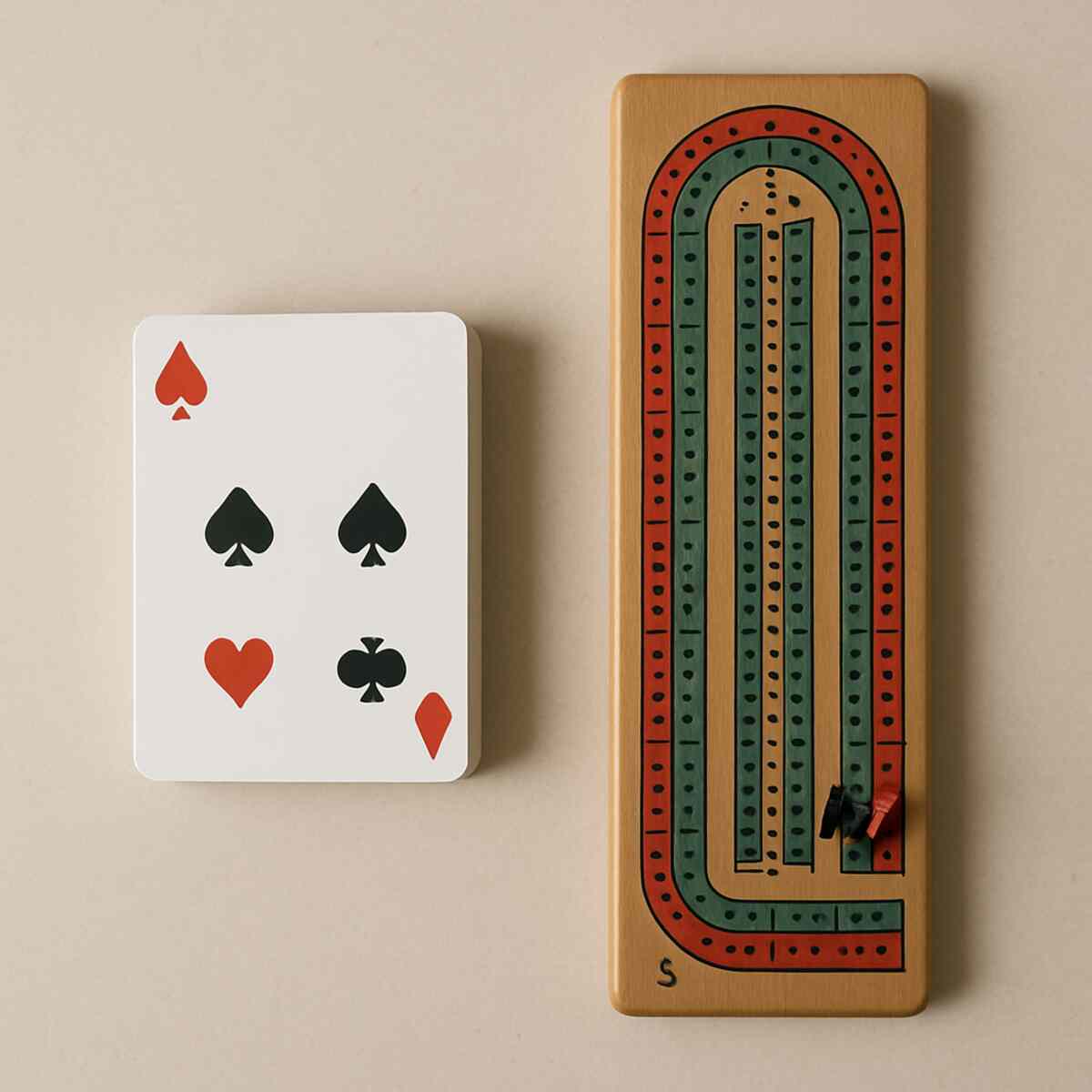
Ever see that strange wooden board with all the holes, maybe at a grandparent’s house or a cozy cabin? That’s a cribbage board, and it’s your ticket to one of the best card games around. It might look complicated, but the secret is that it’s just a game of simple counting. If you can count to 31, you have the main skill needed to play. This guide will get you ready for your first game. The Interesting Info about Alternatif studiobet78.
The goal is straightforward: be the first player to race your peg around the board and score 121 points. To get started, you only need a couple of common items.
What You’ll Need:
- A standard 52-card deck
- A cribbage board with pegs
- 2 players (the focus of this guide)
Every round follows the same simple rhythm, broken into three main parts. First is The Deal, where cards are dealt and each player discards two into a special bonus hand known as the crib. Next comes The Play, where you take turns laying down cards and immediately score points by “pegging.” Finally, there’s The Show, where you each count the scoring combinations in your hands.
That’s the basic flow—a mix of luck from the cards and a bit of strategy in what you play and when. We’ll walk through each step, starting with The Deal.
The Big Picture: How the Board Works and How You Win
At its heart, cribbage is a race. The first person to score 121 points wins the game. Each round, one player is the Dealer, who shuffles and deals the cards. Their opponent is known as the Pone. These roles are important because the dealer gets a slight advantage, so you’ll take turns dealing each round to keep the game fair.
That strange wooden board with all the holes is simply a scoreboard. You track points by moving pegs along the track—a process fittingly called pegging. Each player uses two pegs. When you score, you leapfrog your back peg ahead of your front one by the number of holes you just earned. This clever system always shows you where your last score was and what your new total is, making it easy for both players to follow the action.
The race ends the moment one player’s peg reaches or passes the 121st hole—they win immediately, even if it’s in the middle of a play! For bragging rights, if you win before your opponent scores 91 points, it’s called a “skunk.” With the finish line in sight, you’re ready to take the first step.
The Deal & The Crib: Making Your First Strategic Choice
To begin each round, the dealer shuffles and deals six cards to their opponent (the Pone) and six to themself. You’ll look at these six cards and prepare to make the first, and arguably most important, decision of the round. Your goal is to create the best possible four-card hand for yourself, but you must first discard two cards from the six you were dealt.
This is where cribbage gets its name. The four discarded cards—two from you and two from your opponent—are placed face down to form a special, third hand called the crib. Think of the crib as a bonus hand that only the dealer gets to score at the end of the round. This is the slight advantage that balances the game, which is why the deal alternates each turn. After you’ve both discarded, each player will be holding their final four-card hand.
So, which two cards do you throw away? This is your first bit of cribbage strategy. If you are the Pone (non-dealer), you want to make the dealer’s crib as worthless as possible. A good rule of thumb is to avoid giving away pairs, cards that add to five (like a 2 and 3), or cards that are close in sequence (like a 7 and 8), as these are the building blocks of high-scoring hands.
The dealer, on the other hand, wants to do the exact opposite. Since the crib is your bonus hand, you can toss in cards that have potential, like a pair or two cards that might help form a run. You’re trying to build two good hands at once—the one in your hand and the one in the crib. With four cards left in each hand and the crib set aside, you’re ready for the starter card.
The Cut: What to Do Before Play Begins
Before the turn-by-turn action starts, one more shared card is brought into the game. The non-dealer (Pone) cuts the deck, and the dealer flips over the top card from the remaining pile. This is the starter card, and it’s placed face-up on the deck for all to see.
For now, this starter card just sits there. Its main purpose comes later, acting as a fifth community card that both players will use when counting points at the end of the round. It is not used in the upcoming phase of play.
However, there is one exciting exception. If the card flipped over is a Jack, the dealer has some instant good fortune! They immediately score two points for what’s called “His Heels.” It’s a simple, lucky bonus. The dealer moves their peg two holes, and then you’re finally ready to play.
The Play (Pegging): How to Score Points Turn-by-Turn
Now begins the most active part of the game, often called The Play or pegging, where you score points during play by laying down cards one at a time. The non-dealer starts, placing one card from their hand face-up and announcing its value. Players then alternate, adding the value of their card to a running total called The Count. The fundamental rule here is that The Count cannot exceed 31. (Aces are worth 1, face cards are 10, and all others are their number value).
As you play, your main goal is to create scoring combinations. The most common score is a “Fifteen.” If your card brings The Count to exactly 15, you score two points. For example, if your opponent plays a 7 (announcing “Seven”), and you play an 8, you would announce “Fifteen for two,” and immediately move your peg two holes.
Another way to score is by making a pair. If you play a card of the same rank as the one played just before you, you score two points. Imagine your opponent plays a Queen (The Count is now 10). If you have a Queen, you can play it and say “Pair for two,” moving your peg two spots.
But what happens when you can’t play a card without making The Count go over 31? If The Count is 26, for instance, and you only have cards worth 6 or more, you must say “Go.” This passes the turn. Your opponent must then play any cards they have that can fit under the 31-point limit. If they can play, they do so, scoring any points they make along the way.
Once a player says “Go” and the opponent can’t play any more cards (or also says “Go”), the sequence is over. The very last person to lay down a card earns one point for “The Last Card.” The Count then resets to zero, and play resumes, starting with the player who did not play the last card. This continues until everyone has played all four of their cards.
The Show: How to Systematically Count Your Hand
Once all the cards have been played, the pegging phase is over, and it’s time for The Show. Her,e you score the points hidden in your hand. The order is important: first, the non-dealer (Pone) counts their hand. Then, the dealer counts their hand. Finally, the dealer gets to count their bonus hand, the crib. Remember to add these points to your score from The Play, moving your peg along the board.
For counting, your four cards are combined with the starter card from the beginning, making a five-card hand. To count a cribbage hand quickly and accurately, always use the same systematic order to ensure you don’t miss any points.
Here’s a simple, five-step way to count the points in any hand or crib:
- Fifteens: Find any combination of cards that adds up to 15. Each unique “fifteen” is worth 2 points. (Face cards count as 10, Aces as 1).
- Pairs: Look for pairs of cards with the same rank (e.g., two 7s). Each pair scores 2 points.
- Runs: Find any sequence of three or more cards (e.g., 4-5-6). A run is worth 1 point per card.
- Flushes: If all four cards in your hand (not the starter) are the same suit, you score 4 points. If the starter card is also the same suit, you score 5 points.
- His Nobs: If you hold the Jack that is the same suit as the starter card, you score 1 point for “His Nobs.”
This final point is a common score and easy to spot. Don’t confuse it with “His Heels,” which is when the starter card itself is a Jack, giving the dealer an immediate two points during the cut.
Practice Time: Let’s Count Two Sample Cribbage Hands
Knowing the rules is one thing, but seeing them in action is the best way to make them stick. Let’s walk through the five-step counting method with two different hands.
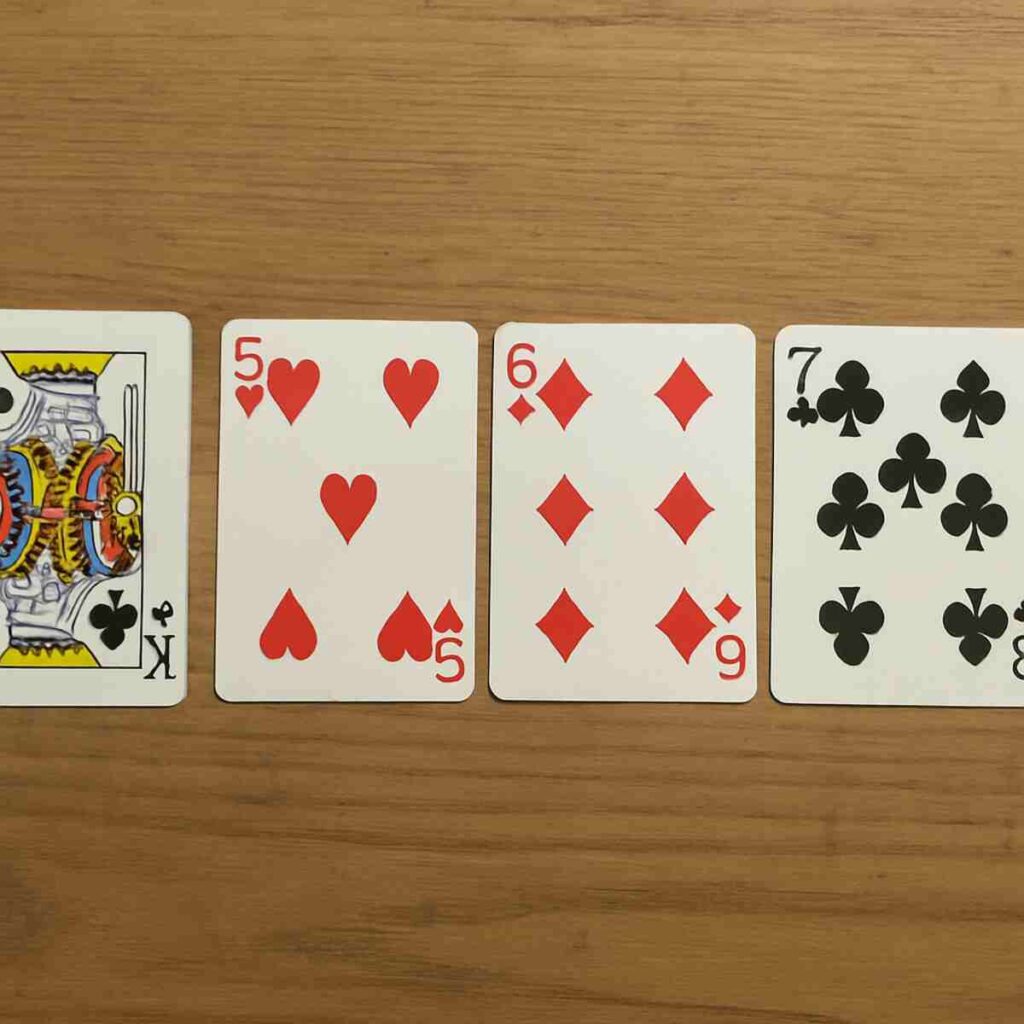
First, imagine you’re holding a 6, 7, 8, 9, and the starter card is a King. Following our system, we first hunt for fifteens. Here, the 6 + 9 make 15 (2 points), and the 7 + 8 also make 15 (2 more points). Next, we check for pairs—none here. Then, we look for runs. The 6-7-8-9 is a clean run of four cards, which scores 4 points. With no flush or Nobs, we add it all up: 4 points from fifteens plus 4 from the run gives you a solid 8-point hand.
Now for a hand built on pairs. Your hand is 2, 2, 8, 8, and the starter card is a 7. There are no runs this time, but the fifteens are plentiful. The starter 7 combines with your first 8 for 15 (2 points), and it also combines with your second 8 for another 15 (2 more points). Next up are the pairs. You have a pair of 2s (2 points) and a pair of 8s (2 points). Add them together, and you get 4 points from fifteens plus 4 from pairs, for another 8-point hand.
Notice how two completely different sets of cards can add up to the same score. The key isn’t memorizing every combination but trusting the counting process.
Your Cribbage Scoring “Cheat Sheet”
Here is a go-to reference guide, perfect for keeping handy as you play. You score points at two different times: first during “The Play” (the pegging round) and then during “The Show” (counting your hand and the crib).
Points During The Play (Pegging)
- Fifteen: Bringing the running count to exactly 15 scores 2 points.
- Pair: Playing a card that matches the rank of the previous card scores 2 points.
- Run of 3+: Playing a card that forms a sequence of 3 or more scores 1 point per card in the run.
- 31: Playing the card that brings the count to exactly 31 scores 2 points.
- Last Card: If you play the last card before the count hits 31, you score 1 point.
After the pegging round is complete, it’s time for “The Show.” This is where you reveal your hand and count all the combinations within it, always including the starter card as a fifth card.
Points During The Show (Counting Your Hand & The Crib)
- Fifteen: Any combination of cards adding to 15 scores 2 points.
- Pair: Two cards of the same rank score 2 points.
- Three of a kind is a Royal Pair—it contains three unique pairs and scores 6 points.
- Four of a kind is a Double Royal Pair—it contains six unique pairs and scores 12 points.
- Run of 3+: Three or more cards in sequence score 1 point per card.
- Flush: Four cards in your hand of the same suit score 4 points. If the starter card is also that suit, it’s 5 points.
- His Nobs: Holding the Jack that matches the starter card’s suit scores 1 point.
- His Heels (Dealer Only): If the starter card is a Jack, the dealer immediately pegs 2 points.
Winning the Game, Avoiding a “Skunk”, and Other Key Rules
The race to 121 points can end in a flash. The game is over the moment a player pegs their 121st point, whether during The Play or The Show. A common mistake beginners make is waiting to peg. Always move your peg for points as you count them—they might just win you the game on the spot!
Now, let’s talk about winning with style. In cribbage, a decisive victory is called a “Skunk.” So, what is a skunk in cribbage? If you reach 121 points before your opponent crosses the 90-point line, you have “skunked” them. In friendly play, this just means bragging rights, but traditionally, a skunk counts as winning two games instead of one.
An even more dominant victory is the “Double Skunk.” This occurs if you reach 121 points while your opponent is still in the first half of the board (hasn’t passed the 60-point mark). A Double Skunk is much rarer and is typically counted as winning four games.
Finally, you might hear experienced players mention the muggins rule, sometimes called “cut-throat” cribbage. This is an optional rule where players must agree to play with it beforehand. If your opponent counts their hand and misses some points, you can shout “Muggins!” and claim the points they missed. For your first few games, it’s best to ignore this rule and focus on learning the ropes, helping each other spot all the points instead.
From Novice to Player: You’re Ready for Your First Game
What once seemed like a cryptic game now has a clear and welcoming rhythm. You’ve walked through the entire flow of a hand: the deal and discard, the starter card, the play-by-play pegging, and the final count. With these essential rules, the mystery is gone, and you have a map for your first round.
The best way to learn is to simply begin. Grab a deck, a board, and a friend, and play an open-handed game where questions are encouraged. Your first goal isn’t to master strategy but to see the rules come alive. Score your first pair or run, and you’ll find the process becomes second nature faster than you think.
Cribbage isn’t just a test of memory but a rewarding and social pastime. Whether you’re settling in for a classic two-player match or adapting the rules for three players, the real objective is connection and enjoyment. The rules will solidify with every hand you play, so embrace the learning curve. The cards are shuffled, and the board is waiting.